

We are excited to share our new electronic health records (EHR) retrieval process with you. However, we also understand that your clients must understand the process and their role in it for this to be a smooth and effortless transition. This brief primer will provide all the information you need to begin explaining electronic medical records (EMR) and their retrieval to your clients. Law firms who sign up or have already signed up with our retrieval service can also receive a more in-depth guide explaining how this process works upon request, as well as instructions and FAQs for your clients.
What Is EHR?
Electronic health records, also referred to as electronic medical records, are the electronic version of an individual’s medical history. Electronic health record systems allow healthcare providers to share records about patients with other providers more easily and securely, improving patient health outcomes. However, electronic medical record systems also allow personal injury law firms who need to access a client’s health records to more easily and securely access them as well.
Why Is EHR Better?
EHR is better for law firms handling personal injury and Social Security disability benefits because it eliminates the need to submit a request to the provider and drastically reduces the time it takes to receive the records. Because the records are received more quickly, the case can move forward more quickly, which means the client can recover their damages more quickly. Of course, there are other factors that determine how quickly a case progresses, but a delay in receiving medical records is one of the most common reasons a case stalls.
Additionally, retrieving records from electronic health record systems can reduce the costs associated with retrieving records. Because there is no request to the provider, there is no provider fee. Firms pay our regular retrieval fee and receive records within 24-48 hours. This naturally reduces the cost to the firm’s client.
What Do You Need to Do?
The EHR retrieval process is the same as the current manual process. Firms will submit their electronic health records retrieval request the same way they currently request retrieval, and if the provider(s) have EMRs, the system will automatically begin the process to request the electronic version.
However, to retrieve the records from electronic health record systems, your client will need to click a link in a text message they will be sent. This means that firms will need to ensure they always have current cell phone numbers for their clients.
What Does Your Client Need to Do?
When your firm submits the request to retrieve EHRs, this will trigger a text message to your client. You will explain to your clients that they will be receiving this text message, which will come from a specific phone number and be clearly branded so that your client will know that this is legitimate.
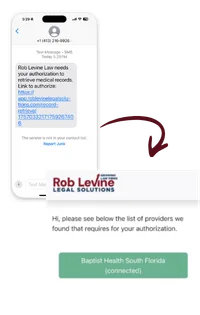
Your client will need to click the link in this text message, which will then securely display all the providers they may need to provide authorization for. They will click on each provider, log in to that provider’s electronic health record system’s portal, and grant authorization for the sharing of the necessary records. Clients will only need to do this once for each provider.
When Will EHR Not Be An Option?
EHR retrieval is a huge leap forward in getting the documentation needed to build a solid personal injury or Social Security disability case, but there are still instances in which it will not be an option.
Currently, EMRs will not be an option in the following instances:
- Requests for billing records
- Requests for radiology films
- When the request requires affidavits or certifications
- When the providers do not have electronic medical record systems
- When the client cannot or will not click the link and provide authorization within 48 hours
Rest assured, even when EHR cannot be used or the client doesn’t authorize the use of EHR, there is always a path forward. EHR does not replace our service, but enhances it. In cases where EHR is unavailable or the client does not authorize its use, the request will automatically fall back to the traditional medical record retrieval process with the same timelines and standard provider fees.
Still Have Questions?
If you or your client have questions about electronic health records or the EHR retrieval process, our team is here to help. We understand that this may be new for many clients, which is why we’re committed to making the process clear, secure, and as simple as possible. We can provide additional firm-facing guidance, step-by-step instructions, and client FAQs to support your conversations and ensure authorizations are completed smoothly. If you’d like a closer look, you can also book a demonstration to see how EHR retrieval works within your existing workflow. As always, our goal is to remove delays, reduce friction, and help your cases move forward efficiently and securely, so you can focus on advocating for your clients while we handle the retrieval.